

Managed IT Services vs. IT Support: What’s the Difference?
Every business relies on technology, but not every business manages its technology the same way. Some companies call an IT provider only when something breaks, while others have a team continuously monitoring and maintaining their systems behind the scenes. Both approaches involve technical support, yet they solve very different problems.
For many business owners, the terms IT support and managed IT services sound interchangeable. It’s an easy mistake to make because both involve fixing computers, solving technical issues, and helping employees stay productive. However, the way these services are delivered—and the value they provide to your business—can be dramatically different.
Choosing the wrong approach can lead to unnecessary downtime, unpredictable expenses, and technology that never seems to stay ahead of your business. Choosing the right one, on the other hand, can improve productivity, strengthen cybersecurity, and allow you to focus on running your business instead of managing IT problems.
This guide explains the differences between IT support and managed IT services, when each approach makes sense, and how to determine which option is the better fit for your organization.
Quick Answer
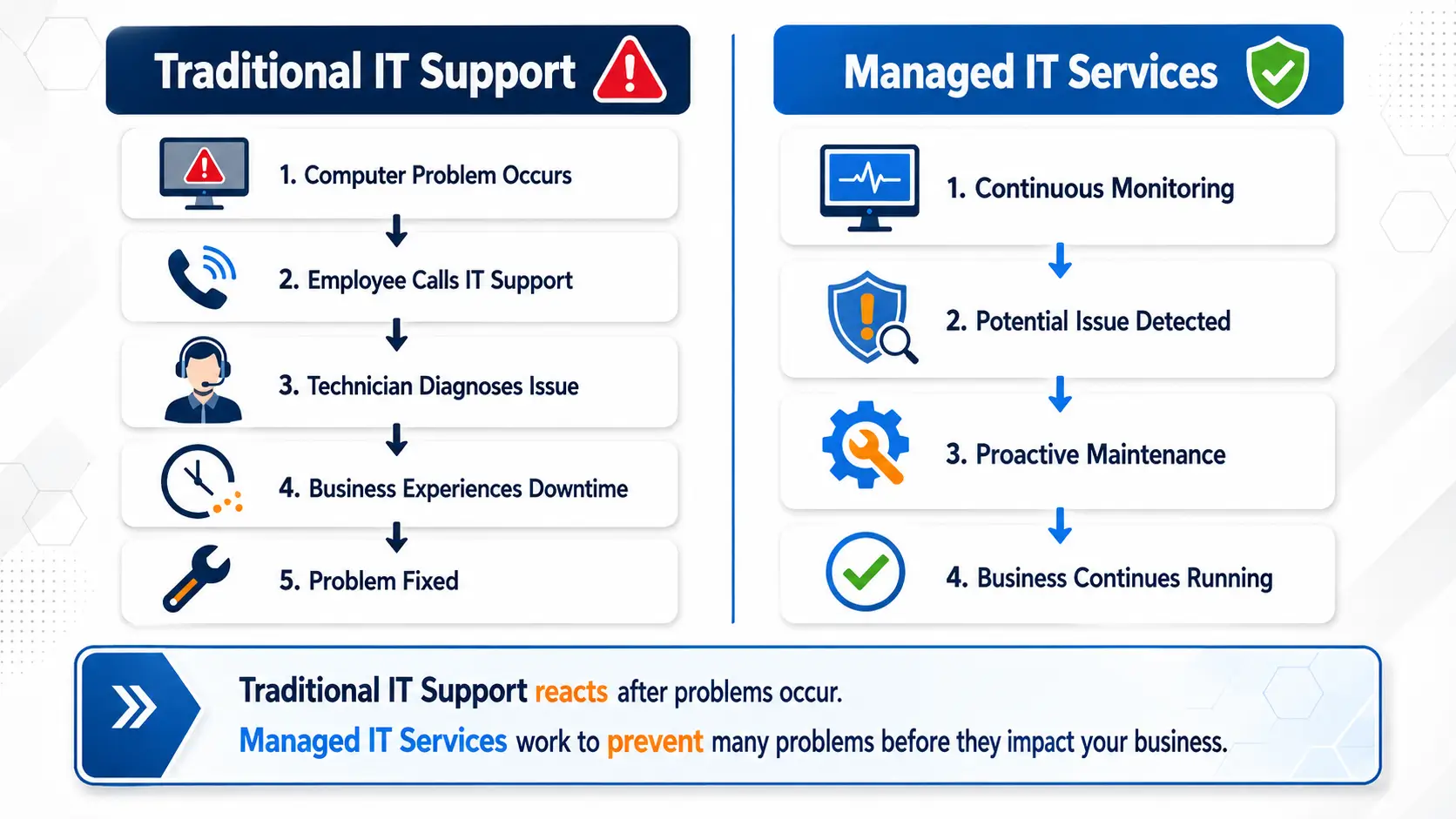
IT support helps resolve technology problems after they occur, while managed IT services focus on preventing those problems from happening in the first place. Traditional IT support is primarily reactive—you contact a technician when something isn’t working. Managed IT services take a proactive approach by continuously monitoring, maintaining, and securing your technology to reduce downtime, improve reliability, and support long-term business goals.
Executive Summary
If you’re short on time, here’s the most important takeaway:
- IT support is primarily reactive and focuses on fixing problems.
- Managed IT services are proactive and designed to prevent many problems before they affect your business.
- Every business benefits from responsive IT support, but organizations that rely heavily on technology often gain greater value from managed IT services.
- The best choice depends on how important technology is to your daily operations, your tolerance for downtime, and your long-term business goals.
At a Glance
| Feature | IT Support | Managed IT Services |
|---|---|---|
| Primary Goal | Resolve technology issues | Prevent technology issues |
| Service Model | Reactive | Proactive |
| Monitoring | Usually limited | Continuous |
| Maintenance | Performed as needed | Ongoing and scheduled |
| Cybersecurity | Basic support | Integrated into ongoing management |
| Cost Structure | Often hourly or per incident | Predictable monthly agreement |
| Best For | Occasional support needs | Businesses that depend on reliable technology |
Table of Contents
- Understanding Traditional IT Support
- What Are Managed IT Services?
- The Biggest Difference Isn’t Technology—It’s Philosophy
- Why This Difference Matters
- Which Businesses Benefit Most from Traditional IT Support?
- Which Businesses Benefit Most from Managed IT Services?
- Can Your Business Use Both?
- The PSI Perspective
- How to Decide Which Approach Is Right for Your Business
- Frequently Asked Questions
- Final Thoughts
Understanding Traditional IT Support
For decades, traditional IT support has been the standard way businesses handled technology problems. When a computer stopped working, an employee couldn’t access email, or the office network went down, someone picked up the phone and called an IT company.
The technician would diagnose the issue, repair the problem, and business would continue as usual.
This approach, commonly referred to as break-fix IT, worked well when technology played a smaller role in day-to-day operations. Years ago, a temporary computer issue might inconvenience one employee without significantly disrupting the entire organization.
Today’s workplaces are different.
Most businesses rely on cloud applications, internet-based phone systems, Microsoft 365, customer relationship management software, file sharing platforms, and online accounting systems. A single technology failure can affect every employee in the office within minutes.
Traditional IT support remains an essential service because problems will always occur. Hardware eventually fails, software develops unexpected issues, and employees occasionally need assistance using the tools they rely on every day.
If your business primarily needs help resolving occasional technology issues, responsive IT Support Services may be all that’s required.
The limitation isn’t the quality of the support—it’s the timing. In a traditional support model, the work usually begins after a problem has already interrupted your business.
What Are Managed IT Services?
Managed IT services take a fundamentally different approach.
Instead of waiting for something to go wrong, a managed service provider works continuously to keep your technology healthy, secure, and operating efficiently. The goal isn’t simply to repair problems quickly; it’s to reduce the number of problems your business experiences in the first place.
Behind the scenes, monitoring software watches over your computers, servers, network equipment, and critical systems around the clock. If a hard drive begins showing signs of failure, storage space starts running low, or a security update hasn’t been installed, technicians are alerted before those issues become major disruptions.
Think of it like maintaining a company vehicle. Regular oil changes, tire rotations, and inspections help prevent unexpected breakdowns. Waiting until the engine fails is almost always more expensive and far more disruptive.
Technology works the same way.
A comprehensive Managed IT Services plan typically includes proactive monitoring, software updates, help desk support, cybersecurity management, backup oversight, vendor coordination, and strategic technology planning. Together, these services create a more stable and predictable IT environment that supports the day-to-day needs of your business.
The Biggest Difference Isn’t Technology—It’s Philosophy
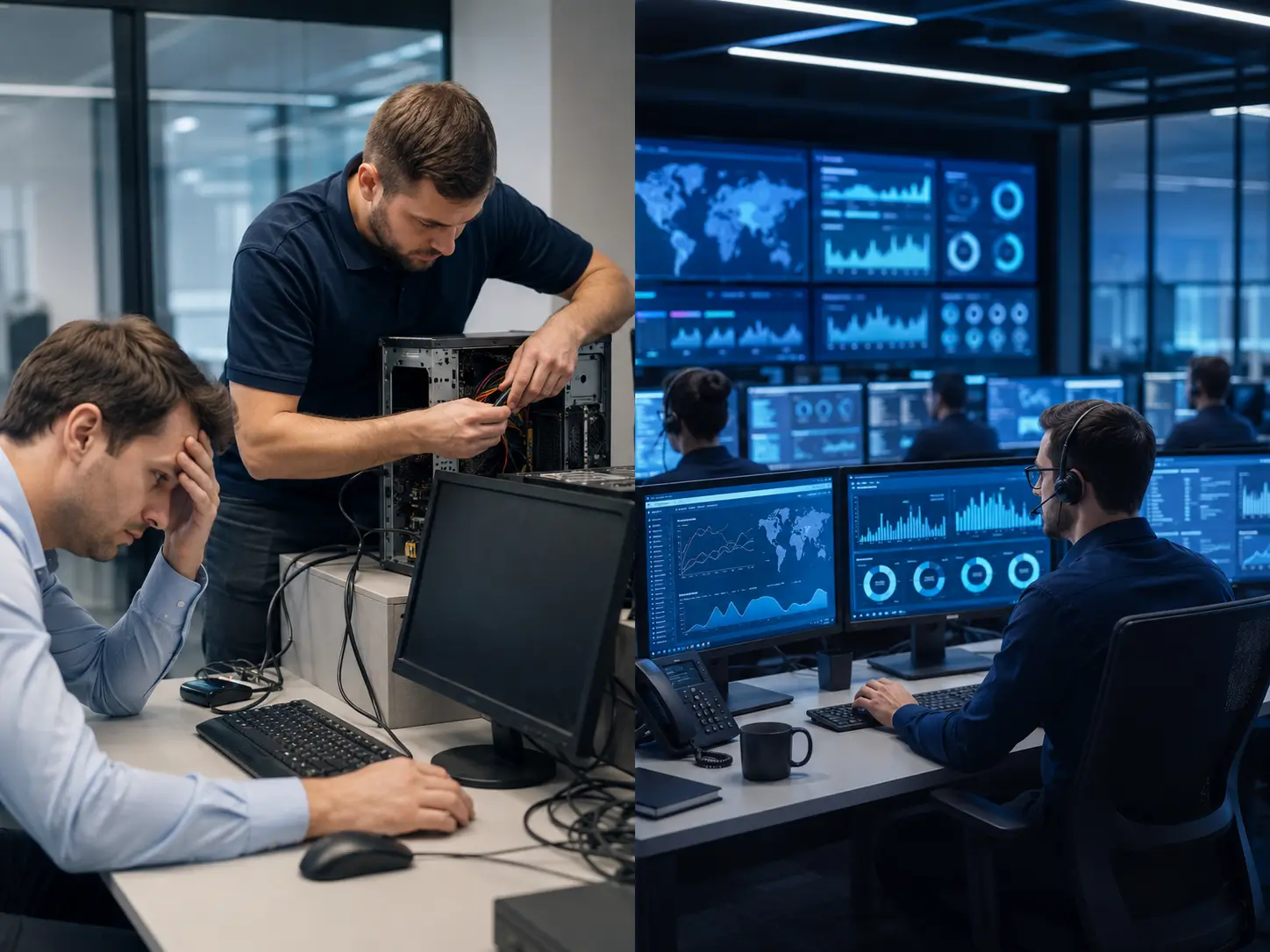
When people compare IT support and managed IT services, they often focus on the tools being used. In reality, the biggest difference is the philosophy behind the service.
Traditional IT support is designed to respond efficiently after a problem has already occurred. Success is measured by how quickly the issue is resolved and employees can return to work.
Managed IT services measure success differently. The objective is to reduce the number of disruptions your business experiences in the first place. If employees can work for weeks or months without major technology issues, that’s evidence the proactive approach is working.
This shift from reacting to preventing changes the relationship between your business and your technology provider. Instead of acting as an emergency repair service, your IT partner becomes an ongoing advisor who continuously looks for ways to improve reliability, strengthen security, and reduce operational risk.
Comparing the Two Approaches
| Category | Traditional IT Support | Managed IT Services |
|---|---|---|
| Responds to technology problems | ✔ | ✔ |
| Prevents future issues | Limited | ✔ |
| Continuous monitoring | Rarely | ✔ |
| Scheduled maintenance | Sometimes | ✔ |
| Strategic technology planning | Rarely | ✔ |
| Cybersecurity management | Basic | Comprehensive |
| Predictable monthly budgeting | Not usually | ✔ |
The comparison isn’t about deciding which service is “better.” Both have value. The real question is which approach aligns with the way your business operates and how much you depend on technology every day.
Why This Difference Matters
Imagine two businesses located in the same office park.
The first company uses traditional IT support. On Monday morning, employees arrive to discover they can’t access shared files because the server failed overnight. The owner contacts the IT provider, a technician begins troubleshooting, replacement parts are ordered, and employees spend much of the day waiting for systems to come back online.
The second company has a managed IT provider. During routine monitoring over the weekend, technicians notice the server’s storage array is reporting hardware errors that suggest an impending failure. Because the issue is detected early, the failing component is replaced before employees arrive on Monday morning. Business continues without interruption, and most employees never know there was a problem.
Both companies received professional IT service.
The difference is when the provider became involved.
That’s the distinction that often matters most to business owners. Downtime isn’t measured only by repair time—it also includes lost productivity, delayed customer service, missed opportunities, and the stress of dealing with unexpected technology failures.
Which Businesses Benefit Most from Traditional IT Support?
Traditional IT support still has an important place in today’s business environment. Not every organization requires a fully managed technology partnership, and for some businesses, reactive support remains a practical solution.
A small office with only a few employees, limited technology, and minimal compliance requirements may only experience occasional technical issues throughout the year. In situations like these, calling an IT professional when something breaks can be both reasonable and cost-effective.
Businesses that primarily use cloud-based software, have very simple networks, or already employ an experienced internal IT professional may also find that traditional support meets their immediate needs.
However, as a business becomes more dependent on technology, the limitations of a reactive model often become more apparent. Frequent support calls, recurring problems, cybersecurity concerns, and unexpected downtime can all signal that it’s time to consider a more proactive approach.
Technology should help your business move forward—not constantly interrupt it.

Which Businesses Benefit Most from Managed IT Services?
Managed IT services are typically the better choice for organizations that rely heavily on technology to operate every day.
If your employees depend on email, cloud applications, file sharing, VoIP phone systems, accounting software, or industry-specific applications, even a short period of downtime can affect productivity and customer service.
Businesses in regulated industries often benefit even more from proactive IT management. Healthcare organizations, government agencies, legal offices, and financial firms all have responsibilities to protect sensitive information while maintaining secure and reliable systems.
Managed IT services help support these objectives by combining ongoing maintenance with stronger cybersecurity, backup monitoring, and long-term planning.
Growing businesses also appreciate the scalability of managed services. Instead of hiring additional internal IT staff every time the company expands, they can rely on a technology partner that grows alongside them.
The result is predictable support, better planning, and fewer unexpected disruptions.
Can Your Business Use Both?
Absolutely.
One of the biggest misconceptions is that businesses must choose either IT support or managed IT services.
In reality, managed IT services already include IT support.
When employees have problems with their computers, printers, software, or email, they still contact the help desk for assistance. The difference is that managed service providers are also working behind the scenes to prevent many of those issues from occurring in the first place.
Think of it this way.
If IT support is the fire department responding after smoke appears, managed IT services are the smoke detectors, fire inspections, and preventative maintenance designed to reduce the chance of a fire ever starting.
Both are valuable. One simply begins much earlier than the other.
The PSI Perspective
At Perfection Services Inc., we’ve always believed technology should quietly support your business—not constantly demand your attention.
Businesses don’t invest in IT because they enjoy managing computers. They invest in technology because it helps serve customers, improve efficiency, and support growth.
That’s why our philosophy centers on proactive management rather than reactive repairs. While responsive support will always be important, our goal is to reduce the number of support calls your business needs in the first place.
When systems are monitored, maintained, and secured on an ongoing basis, your employees spend less time dealing with technology issues and more time focusing on the work that moves your business forward.
Signature Insight
One of the simplest ways to remember the difference between these two services is this:
IT support helps you recover from technology problems. Managed IT services help you avoid many of those problems altogether.
That’s not just a difference in service—it’s a difference in business strategy.
Organizations that view technology as an essential part of their operations often discover that prevention is far less disruptive—and usually far less expensive—than recovery.
How to Decide Which Approach Is Right for Your Business
Choosing between traditional IT support and managed IT services isn’t really about selecting one service over another. It’s about deciding how you want technology to support your business.
If technology isn’t central to your daily operations and issues are rare, traditional IT support may be all you need.
If your employees depend on reliable systems every day, unexpected downtime affects customers, or cybersecurity has become a growing concern, managed IT services often provide greater long-term value.
Ask yourself a few simple questions:
- How much does an hour of downtime cost our business?
- Are we usually fixing problems after they occur?
- Do we have a long-term technology plan?
- Are we confident our cybersecurity measures are keeping pace with today’s threats?
- Would our business benefit from having a trusted technology advisor instead of simply an emergency repair service?
The answers to those questions often make the right choice much clearer.
Frequently Asked Questions
Is managed IT the same as IT support?
No. IT support focuses on resolving technology issues after they occur, while managed IT services include ongoing monitoring, maintenance, cybersecurity, strategic planning, and help desk support designed to prevent many issues before they disrupt your business.
Can a business have both IT support and managed IT services?
Yes. In fact, managed IT services typically include IT support as part of a broader technology management strategy. Employees still receive help when problems arise, but proactive maintenance helps reduce the number of issues they experience.
Is managed IT more expensive than traditional IT support?
The pricing models are different. Traditional IT support is often billed hourly or per incident, while managed IT services usually involve a predictable monthly agreement. Although managed IT may appear to cost more upfront, many businesses find it reduces downtime, emergency repairs, and long-term technology expenses.
When should a business switch to managed IT services?
Businesses often consider managed IT services when technology becomes critical to daily operations, support requests become more frequent, cybersecurity concerns increase, or they want predictable IT costs and proactive technology planning.
Do managed IT services replace an internal IT department?
Not necessarily. Some organizations use managed IT services instead of hiring internal staff, while others use them to supplement their existing IT team with additional expertise, cybersecurity support, and around-the-clock monitoring.
Final Thoughts
Technology has become one of the most valuable assets a business owns, but it’s also one of the easiest things to overlook until something goes wrong.
Traditional IT support and managed IT services both play important roles, but they solve different business challenges. One focuses on responding to issues efficiently, while the other is designed to reduce the number of issues your business experiences in the first place.
As technology continues to become more important to productivity, customer service, and cybersecurity, many organizations are discovering that a proactive approach delivers greater stability and fewer unexpected disruptions.
The best choice isn’t simply the service with the lowest monthly cost. It’s the one that gives your business the confidence that your technology will support your goals instead of standing in the way of them.
Continue Learning
If you found this guide helpful, you may also be interested in:
- What Are Managed IT Services?
- How Much Do Managed IT Services Cost for Small Businesses?
- 10 Signs Your Business Has Outgrown Break-Fix IT
- How Often Should a Business Back Up Its Data?
Together, these guides provide a deeper understanding of how proactive technology management can improve reliability, strengthen cybersecurity, and support long-term business growth.

Ready to Talk About Your IT Strategy?
Every business is different, and there isn’t a one-size-fits-all approach to IT.
Whether you’re evaluating your current provider, comparing managed IT services with traditional support, or simply looking for a second opinion, Perfection Services Inc. is here to help.
We’ll take the time to understand your business, answer your questions in plain language, and recommend solutions that fit your goals—not just your technology.
If you’d like to discuss your current IT environment or explore how a proactive approach could benefit your organization, let’s start the conversation.